
Austin DWI
The Real Truth About an Austin DWI: What You Need to Know to Save Time, Money, and Fight for Dismissal, Reduced Charges, or an Acquittal
If you’ve been arrested for DWI in Austin, you’ve probably discovered that most attorney websites tell you the same things: how much jail time you’re facing, how expensive the fines can be, and why you need to hire a lawyer.
They use fear and scare tactics to win you over. Well, that doesn’t work. What does work is facing your DWI charge head-on and fighting to beat it.
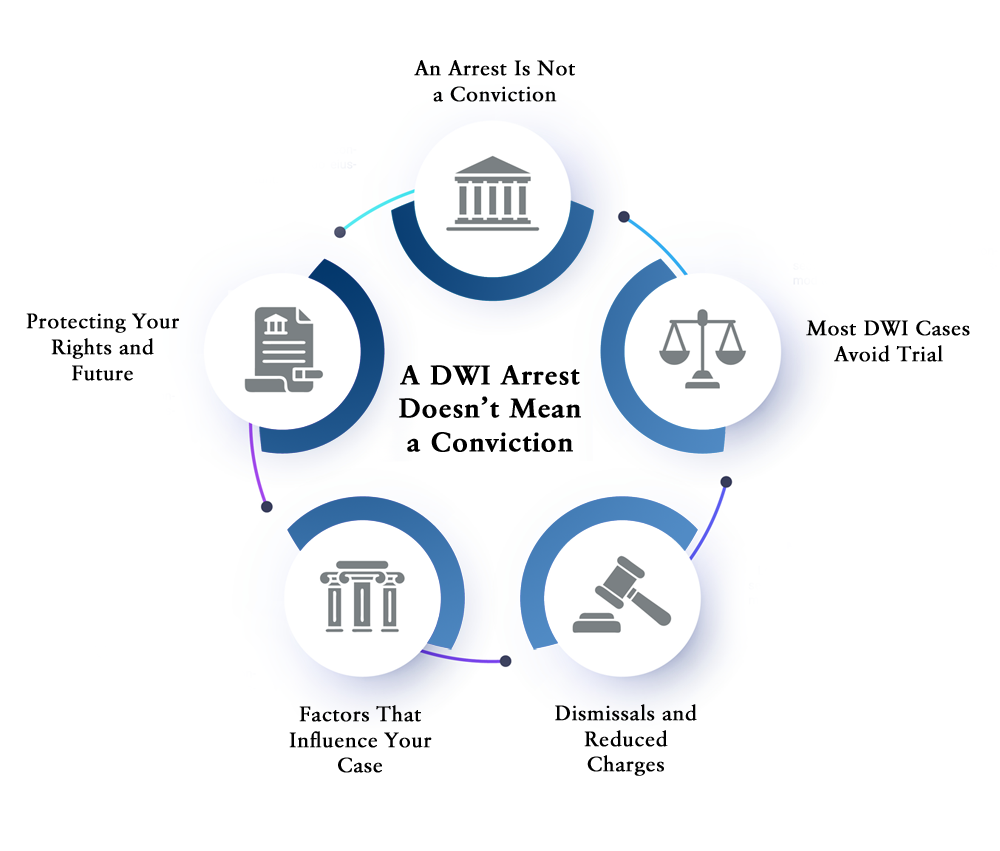 An Austin DWI Arrest Doesn’t Mean You’ll Be Convicted
The truth is that an Austin DWI arrest doesn’t automatically mean jail time, a criminal conviction, or a permanent criminal record.
Most criminal cases, including DWI cases, are resolved without a jury trial. Many end through negotiated agreements, and the possible outcomes can be very different from the maximum penalties listed under Texas law.
Depending on the circumstances, an Austin DWI case may result in dismissal, reduced charges, pretrial diversion, or deferred adjudication. The outcome depends on several factors, including the strength of the evidence, your prior criminal history, whether an accident occurred, your blood alcohol concentration, and how thoroughly your case is defended.
The purpose of this guide is to help you understand how Austin DWI cases actually work internally so you can make better decisions, avoid unnecessary expenses, and protect your future.
Just Because the Police Say You Were Intoxicated Doesn’t Mean They Can Prove It
Before you read any further, there’s something you need to understand. Just because the police say you were intoxicated doesn’t mean they can prove it.
Breath tests can be wrong. Field sobriety tests can be difficult to pass even when you’re completely sober. Blood tests aren’t foolproof, either. And police officers make mistakes, misinterpret what they see, and sometimes get things flat-out wrong.
Maybe you stumbled during a field sobriety test. Maybe you think you looked terrible on the officer’s body camera footage. Maybe your breath test showed you were over the legal limit.
Don’t panic. And don’t assume you’re going to be convicted.
The prosecution has to prove its case beyond a reasonable doubt. That’s a high bar, and it’s not always as easy as the police or prosecutors might make you think. Even evidence that looks terrible at first can fall apart when an experienced DWI defense attorney starts digging into it.
Your case may be a whole lot more defensible than you realize.
What You Need to Know Before Hiring a DWI Defense Attorney
Whether you hire a private attorney or qualify for a court-appointed lawyer, there are some important things you need to know before making decisions that could affect the rest of your life.
An Austin DWI Arrest Can Trigger Two Separate Legal Proceedings
Most people think a DWI arrest means they have one criminal case to defend. In reality, Texas may pursue two separate actions against you: the first threatens your driver’s license, and the second threatens a criminal conviction and record. Most people don’t realize you can fight both and win.
First: The State Wants to Suspend Your Driver’s License
You would think that you are innocent until proven guilty, but if police think someone is driving while intoxicated, they can immediately restrict that person’s ability to drive after an arrest by initiating a driver’s license suspension.
Fortunately, an experienced DWI defense attorney can challenge the suspension at an Administrative License Revocation (ALR) hearing and fight to get the license back. The attorney can challenge the officer’s reasons for stopping and arresting the driver, expose mistakes, and make the state prove its case. These hearings are often easier to win than people think.
There are only 15 days to request a hearing, so time is critical. Requesting it on time stops the suspension from taking effect while the attorney fights to protect your right to drive.
And here’s the best part: the attorney can use the hearing to question the arresting officer under oath and uncover evidence that helps fight the criminal DWI charge.
That’s two potential wins: protecting the driver’s license and gathering evidence to get the DWI charge dismissed or reduced. The goal is simple: get the driver back on the road and make the DWI charge go away.
Second: The State Wants to Convict You of DWI
The police and prosecutors have one goal: to prove you were driving while intoxicated. But here’s what they don’t want you to understand: the burden of proof is on them, not you. They have to prove their case beyond a reasonable doubt. When an experienced DWI defense attorney successfully challenges the evidence and gets much of it thrown out, proving that case becomes a whole lot harder. After all, how do you prove someone was intoxicated when you no longer have the evidence to back it up?
During a DWI investigation, police officers rely heavily on roadside observations, field sobriety tests, and chemical testing to determine whether someone is intoxicated. But these observations and tests are not always as objective or reliable as they may appear.
Consider the officer’s perspective. Police officers have a responsibility to protect the public from potentially impaired drivers and don’t want to release someone who could pose a danger to others. Consequently, something as simple as the odor of alcohol can trigger suspicion and influence how everything that follows is interpreted.
This creates the potential for confirmation bias, where an officer begins looking for evidence that supports an initial suspicion of intoxication while overlooking other explanations.
But the officer doesn’t know you. They don’t know your natural mannerisms, how you normally speak or walk, your physical limitations, your personality, or your individual quirks. They don’t know whether your eyes are naturally bloodshot, whether you have difficulty balancing, or whether nervousness affects how you communicate.
Now consider the circumstances. You’re standing on the shoulder of a busy road, possibly late at night, surrounded by flashing police lights, passing traffic, unfamiliar instructions, and the fear of being arrested. Even someone who hasn’t consumed a drop of alcohol may struggle under those conditions.
The problem is that an officer’s subjective interpretations can become the foundation of the prosecution’s case, while your side of the story, important details, and alternative explanations get lost along the way.
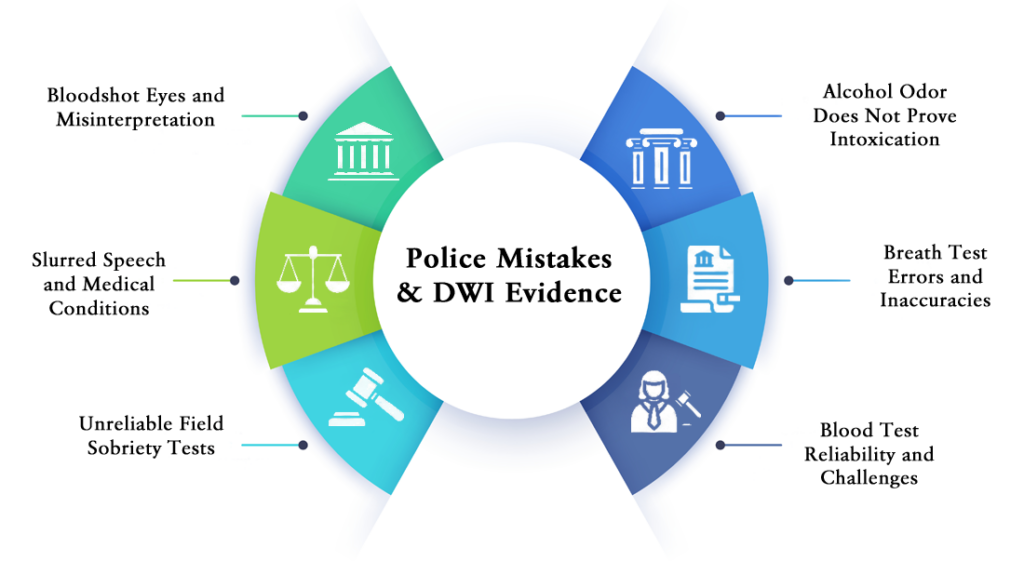
Police Officers Make Mistakes, and Not Everything They Observe Proves Intoxication
Bloodshot Eyes
An officer may report that your eyes were red, bloodshot, or watery. But imagine someone who has just finished a 12-hour shift, suffers from seasonal allergies, or wears irritating contact lenses. Without knowing any of this, an officer may interpret those symptoms as evidence of intoxication. Bloodshot eyes alone do not prove someone has been drinking or is intoxicated.
Slurred Speech
An officer may describe your speech as slurred or unusual. But how does someone who has never spoken with you before know what your normal speech sounds like? Imagine someone with a natural speech impediment, a regional accent, or a medical condition that affects pronunciation. Add the stress of an unexpected police encounter, and their speech may sound even more unusual. An officer’s interpretation may be sincere, but that doesn’t make it accurate.
Field Sobriety Tests
Roadside field sobriety tests are designed to identify clues associated with impairment, but their results can be influenced by physical limitations, environmental conditions, and how the tests are administered.
Imagine a 55-year-old construction worker with an old knee injury being asked to stand on one leg, or someone with an inner ear condition attempting to walk heel-to-toe on uneven pavement. Now add flashing lights, passing traffic, confusing instructions, and the anxiety of arrest.
If they lose their balance or make a mistake, the officer may record it as a clue of intoxication. But was the mistake caused by alcohol, or by something entirely unrelated? Even sober people can struggle with these tests, and poor performance does not automatically establish intoxication.
The Smell of Alcohol
An officer may accurately report smelling alcohol on your breath, but that doesn’t establish your blood alcohol concentration or prove impairment.
Imagine someone who had one beer with dinner and is driving home several hours later. The officer smells alcohol and begins a DWI investigation. From that point forward, ordinary behaviors such as nervousness, bloodshot eyes, or hesitation when answering questions may be interpreted as additional evidence of intoxication.
The odor may justify further investigation and contribute to probable cause when combined with other evidence, but consuming alcohol and driving while legally intoxicated are two different things.
Breath Test Results Can Be Wrong
A breath test showing a blood alcohol concentration (BAC) of 0.08 or higher can be powerful evidence in a Texas DWI case, but breath testing estimates BAC from a breath sample rather than measuring it directly.
Imagine someone with severe acid reflux or GERD. If alcohol from the stomach enters the mouth shortly before testing, residual mouth alcohol may contaminate the sample and produce an artificially elevated reading. Improper testing procedures, equipment problems, calibration issues, and certain medical conditions can also affect reliability.
A reported BAC of 0.12 may appear overwhelming, but what if medical issues, foods, or liquids inflated the reading? The sad reality is that these tests are not 100% accurate and can sometimes produce false readings.
An experienced Austin DWI attorney can examine testing records, equipment maintenance, procedures, and medical evidence to determine whether the result is reliable. A number on a machine is only as trustworthy as the science and procedures behind it.
Blood Tests Can Also Be Challenged
Blood tests are generally considered strong scientific evidence, but their reliability depends on proper collection, handling, storage, analysis, and interpretation.
Imagine a blood sample that was improperly stored, collected using compromised equipment, or analyzed without following established laboratory procedures. Or consider someone who consumed alcohol shortly before driving: their BAC may have continued rising after the traffic stop, meaning a blood test taken an hour later could show a higher concentration than existed while they were driving.
That distinction matters because the prosecution must establish intoxication at the time of driving, not simply when a sample was collected later. A skilled DWI defense attorney can investigate laboratory records, chain of custody, collection procedures, testing methods, and the timing of the blood draw to identify weaknesses in the evidence.
Conducting an Independent Investigation
Body camera footage, dashcam recordings, medical records, witness statements, and testing records may reveal circumstances the officer misunderstood or overlooked. Often, the investigation is the linchpin to winning a DWI case, and a thorough defense begins immediately—going far beyond reviewing police reports.
- Investigating Breath and Blood Test Evidence: Attorneys promptly request testing records, instrument calibration and maintenance logs, inspection reports, testing data, and officer certification records to identify errors or reliability issues. They investigate whether the breath testing instrument functioned properly, whether required procedures were followed, whether medical conditions or mouth alcohol affected the results, and whether the reported BAC reflected the person’s alcohol concentration at the time of driving.
- Returning to the Scene of the Arrest: Attorneys return to the scene to photograph road conditions, measure slopes and uneven surfaces, examine lighting, and reconstruct the circumstances under which field sobriety tests were administered.
- Locating Witnesses and Uncovering Overlooked Evidence: Investigators locate and interview witnesses, obtain surveillance footage from nearby businesses, identify cellphone videos recorded by bystanders, and uncover evidence police never collected.
- Analyzing Police Reports and Video Evidence: Investigators analyze body camera and dashcam footage frame by frame, compare the recordings with officers’ written reports, identify inconsistencies, and examine whether the evidence supports the officer’s conclusions.
- Consulting Forensic and Scientific Experts: Attorneys consult forensic toxicologists, medical professionals, and other scientific experts to independently evaluate the prosecution’s evidence, challenge questionable findings, and identify alternative explanations for observations attributed to intoxication.
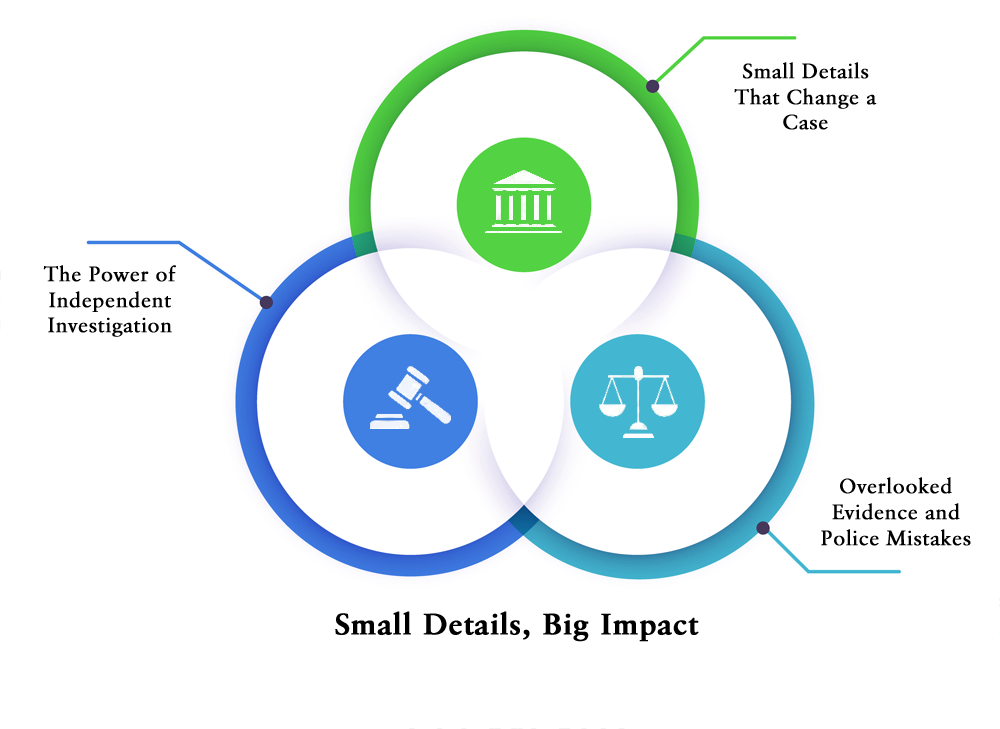 The Smallest Details Can Make the Biggest Difference
Sometimes, the smallest details—a sloped roadway, improperly administered sobriety test, overlooked medical condition, independent witness account, or unreliable breath test result—can fundamentally change how a case is understood.
The prosecution’s case tells one version of what happened. A thorough independent investigation can reveal what was missed, misunderstood, or never investigated, providing a more complete and objective picture.
Key Stages of the Austin DWI Legal Process and What Happens at Your Court Dates
Most people arrested for DWI have never been through the criminal justice system and don’t know what happens at their first court date, how many times their case may be scheduled, whether they must appear personally, or how long resolution takes. Understanding these procedures helps you avoid confusion, missed court dates, and unnecessary expenses.
Arrest and Release
After a DWI arrest in Travis County, you will typically go through booking, bond, and release. A judge may impose restrictions such as alcohol testing, ignition interlock devices, monitoring, or regular check-ins. An experienced DWI defense attorney can challenge these restrictions and potentially have them reduced or lifted through early intervention, especially when evidence reveals a different story about what happened during your arrest.
Administrative License Revocation (ALR) Hearing
Separate from criminal court proceedings, the ALR hearing determines whether your driver’s license should be administratively suspended following a chemical-test refusal or failure. Your attorney may challenge the evidence supporting the suspension and, depending on the circumstances, question the arresting officer under oath. A successful hearing prevents the administrative suspension, and information obtained during it can also aid the criminal case.
Initial Court Appearance or Arraignment
The first criminal court date is procedural, not a trial. The court addresses pending charges, legal representation, bond conditions, and scheduling, and the defense generally enters a plea of not guilty.
Depending on the court and proceeding, your attorney may appear on your behalf, while other hearings require your personal attendance. Never assume hiring an attorney excuses you from appearing; follow the court’s instructions and confirm attendance requirements with your lawyer.
Discovery and Evidence Review
During discovery, the prosecution provides required evidence to the defense. Your attorney examines police reports, body camera and dashcam footage, field sobriety testing, and chemical testing records to identify inconsistencies, unreliable evidence, procedural errors, and constitutional violations.
When legally justified, your attorney may seek to have evidence excluded. The less admissible evidence the prosecution has, the harder it becomes to prove the charge.
Pretrial Court Dates
A DWI case may require multiple pretrial court dates before resolution. These settings involve the defense attorney and prosecutor reviewing case status, discussing evidence, addressing legal issues, and negotiating resolutions—not necessarily presenting evidence or arguing before a judge.
Additional court dates often occur because the defense is waiting for police video or lab records, or needs time to investigate discrepancies, consult experts, or prepare motions. Depending on court requirements, an attorney may handle routine settings without the client appearing in person. The number of court dates does not indicate whether a case is strong or weak; what matters is the work performed and whether the proceedings serve a legitimate purpose.
Motion Hearings
A motion hearing occurs when the court must decide a legal issue raised by the defense or prosecution—such as whether police had a lawful reason to stop your vehicle, whether probable cause existed for the arrest, or whether specific evidence should be admitted.
The judge hears testimony, reviews evidence, and considers legal arguments before ruling. If critical evidence is suppressed or excluded, prosecutors face greater difficulty proving the charge, which can shift subsequent negotiations and resolution options.
Plea Negotiations
During negotiations, the defense and prosecution evaluate the evidence, legal issues, prior criminal history, and offense circumstances. An attorney may seek dismissal, reduction to a non-DWI offense, pretrial diversion, deferred adjudication when available, or another appropriate resolution.
Evidence challenges directly affect the prosecution’s willingness to negotiate. If important evidence is suppressed or an officer’s testimony conflicts with a recording, the prosecution may reassess whether it can win at trial. Negotiations may also address court-imposed conditions and expenses when legally permissible.
Plea Hearing
When a negotiated agreement requires a plea, the judge reviews the proposed resolution at a plea hearing to determine whether to accept it. Depending on the agreement, you may need to appear personally, answer the judge’s questions, and acknowledge the rights you are waiving.
Consequences depend on the disposition: a reduction to another criminal offense may still result in a conviction; deferred adjudication avoids a final conviction upon successful completion, though it does not automatically erase the record; and pretrial diversion provides eligible defendants a path to dismissal without entering a guilty plea. Understanding these distinctions before accepting an agreement is essential.
Trial
If negotiations do not produce an acceptable resolution, the case proceeds to trial, where prosecutors must prove every element of the DWI charge beyond a reasonable doubt. Your attorney can challenge witnesses, question scientific evidence, expose inconsistencies, and present a defense supported by the facts before the judge or jury issues a verdict.
Preparing for trial also strengthens negotiations, because prosecutors must weigh the vulnerabilities of their evidence against the risks of proceeding.
Most DWI Cases Never Go to Trial. So What Actually Happens?
While many imagine criminal cases ending with a jury verdict, most are resolved through negotiations instead.
What Makes a DWI Case More Difficult to Negotiate?
- A high blood alcohol concentration: A substantially elevated BAC increases potential penalties and can disqualify you from alternative programs.
- An accident: A collision—particularly one involving injuries—creates additional legal consequences and public safety concerns.
- Prior DWI offenses: Previous convictions increase penalties and limit available alternatives.
- Police video: Recordings supporting the officer’s observations strengthen the prosecution’s case, while contradictory or incomplete recordings create opportunities for the defense.
- Problems with the evidence: An unlawful stop, unreliable chemical test, inconsistent testimony, or improperly obtained evidence weakens the prosecution’s position.
These variables explain why two people arrested for DWI in Austin may receive very different offers.
What Outcomes Are Possible?
- Pretrial diversion: Eligible defendants complete an agreement with prosecutors that results in dismissal without a guilty plea.
- Deferred adjudication: Eligible defendants enter a guilty or no-contest plea and complete supervision without receiving a final conviction if they satisfy all conditions.
- Reduced charges: Prosecutors agree to reduce a DWI to another offense when the evidence and circumstances support it.
- Dismissal: Prosecutors drop the case when evidence is insufficient or other circumstances justify dismissal.
- Acquittal: A defendant is found not guilty at trial if prosecutors fail to prove the charge beyond a reasonable doubt.
- Conviction with probation: Defendants receive community supervision instead of additional jail time, though the conviction remains on their criminal history.
The key question isn’t simply whether your attorney can negotiate a plea agreement, but what that agreement means for your future.
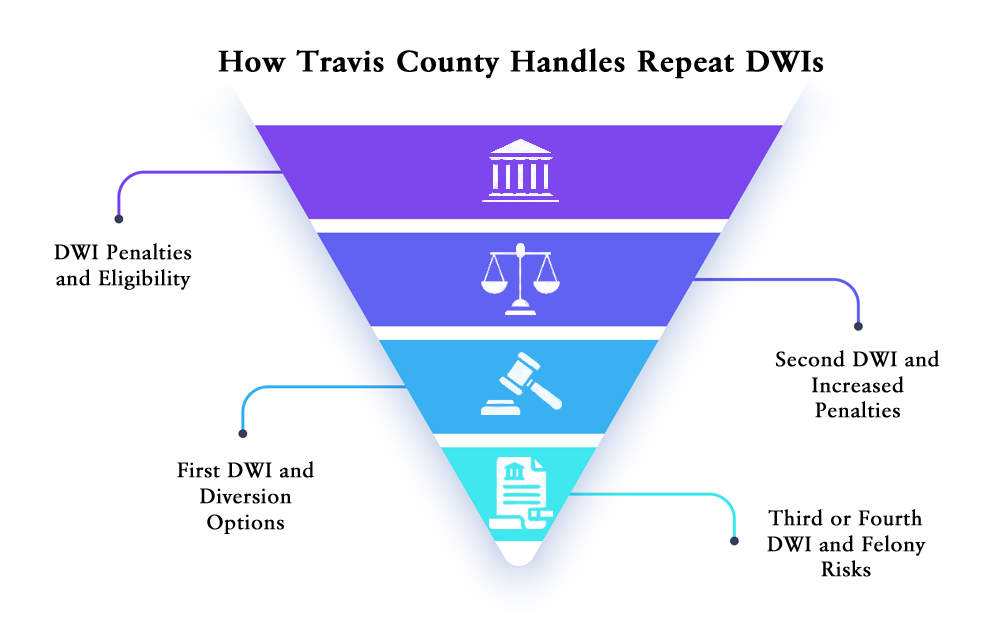 Travis County Looks at First, Second, Third, and Subsequent DWI Offenses Differently
Not every person arrested for DWI has the same history, circumstances, or underlying problems, and Texas law reflects this through varying offense classifications, penalties, and eligibility requirements.
First DWI: An Isolated Mistake or a Criminal Conviction That Follows You for Years?
For some, a first DWI arrest is an isolated error in judgment—perhaps involving someone with no criminal history, a stable career, and a family depending on them. Others are arrested despite legitimate questions about whether they were actually intoxicated.
Should one mistake automatically result in a permanent criminal conviction? Travis County offers certain eligible first-time DWI defendants access to pretrial diversion and other resolutions that provide education, supervision, and treatment when appropriate—offering a path to avoid a final conviction. These programs don’t overlook the seriousness of DWI; they recognize that different circumstances justify different outcomes.
Second DWI: Is There a Pattern That Needs Attention?
A second DWI allegation brings more serious penalties and often disqualifies the defendant from programs available to first-time offenders. While a repeat offense may raise questions about alcohol use or whether treatment would be beneficial, two arrests do not automatically prove a substance abuse disorder. The defense must still examine the evidence while considering whether rehabilitation or other interventions are appropriate.
Third or Fourth DWI: When Treatment and Criminal Defense May Both Be Important
A third DWI involving qualifying prior convictions is generally prosecuted as a felony in Texas, with additional convictions increasing sentencing consequences. Repeated offenses may suggest an underlying alcohol or substance use issue deserving professional evaluation, making treatment and rehabilitation important components of addressing the situation.
However, the right to a thorough defense doesn’t disappear with prior convictions. Whether it’s a first DWI or a fourth, the government must still prove the current charge.
Why an Independent Investigation Can Change an Austin DWI Case
Reviewing the traffic stop, arrest, field sobriety tests, chemical testing, officer testimony, and recordings allows the defense to uncover police mistakes, contradictory evidence, unreliable scientific conclusions, and constitutional violations.
When evidence is obtained unlawfully, an attorney can move to exclude it. When an officer’s account conflicts with video, the defense can challenge their credibility. When scientific testing has legitimate flaws, those weaknesses can be presented to prosecutors or the court.
Each finding can shift the strength of the case, prompting prosecutors to reconsider dismissal, reduced charges, or diversion. While an investigation doesn’t guarantee dismissal or acquittal, simply accepting the police report leaves critical questions unanswered.
Avoiding Jail Is Not the Same as Avoiding a Criminal Conviction
Avoiding additional jail time by completing probation still leaves you with a criminal conviction—which is very different from completing pretrial diversion for a dismissal and expunction, or completing deferred adjudication to avoid a final conviction without automatically erasing the record. Because these outcomes are not interchangeable, understanding the exact definitions is vital:
- Dismissal: The prosecution drops the charge.
- Expunction: A legal process that permanently removes eligible arrest and criminal records.
- Deferred adjudication: Allows an eligible defendant to avoid a final conviction after successful supervision, though arrest and court records do not automatically disappear.
- Nondisclosure: Restricts public access to eligible records, though authorized government agencies and certain entities retain access.
- Conviction: A finding of guilt or a plea resulting in a judgment of guilt (some qualifying first-time misdemeanor DWI convictions may later be eligible for nondisclosure).
What Does an Austin DWI Really Cost, and Which Expenses Can Be Reduced?
Statutory fines are only part of the financial picture. Depending on the case, costs may include attorney fees, court costs, bond expenses, alcohol education, community supervision, ignition interlock devices, alcohol monitoring, driver’s license reinstatement, and higher insurance premiums—alongside potential impacts on employment and professional licensing.
However, someone whose case is dismissed faces very different financial consequences than someone placed on probation or in a diversion program. Supervision length, required programs, and resolution terms all affect total cost:
- Court Costs and Fines: Some are mandatory, while others are subject to judicial discretion, financial-hardship provisions, or negotiation. An attorney can identify which can be reduced, waived, or avoided.
- Ignition Interlock Devices: Involve installation, monthly monitoring, maintenance, and removal fees. While some requirements are mandatory, an attorney can challenge or negotiate discretionary bond or supervision conditions.
- Alcohol Monitoring and Testing: Recurring testing expenses throughout supervision can sometimes be negotiated in duration, frequency, or type when legally permissible.
- Probation and Education Programs: Community supervision, alcohol education, and treatment carry fees that an attorney may be able to reduce or replace with alternatives.
- Driver’s License Suspension and Reinstatement: Suspensions trigger reinstatement fees, transportation costs, and lost work opportunities—expenses an ALR hearing can help you avoid.
- Insurance and Long-Term Financial Consequences: Increased auto insurance premiums and career impacts can continue long after the criminal case ends.
Why Negotiating the Financial Terms Matters
Even when a DWI conviction is avoided, the final resolution may carry court costs, fines, interlock requirements, or monitoring conditions. Negotiating down discretionary requirements or shortening monitoring periods can save hundreds or thousands of dollars, while avoiding a conviction or license suspension prevents long-term financial fallout. Saving money isn’t about hiring the cheapest attorney or taking the fastest plea—it’s about understanding the full financial and legal impact of your options.
What Should You Ask Any Austin DWI Lawyer Before Hiring Them?
Whether you hire a private attorney or qualify for court-appointed representation, make sure you understand how your case will be handled:
- Ask how many ALR hearings they have won.
- Ask who will actually handle your case and ask to see their track record of case and trial wins.
- Ask what credentials and training they have in DWI defense. Most experienced DWI lawyers have taken the same field sobriety tests police administer, and many have completed the same scientific training in breath testing.
The Real Truth About an Austin DWI
Is a DWI Charge Serious? Absolutely. But That Doesn’t Mean You’ll Be Convicted.
Does everyone go to jail? No. Does everyone end up with a conviction? No. And that’s where having an experienced DWI defense attorney can make all the difference.
Fight to Get Your Driver’s License Back
The first step is fighting to protect your driver’s license at an Administrative License Revocation (ALR) hearing. Winning can prevent the suspension, but the hearing also creates an opportunity to question the arresting officer under oath and uncover evidence that can help defeat the criminal DWI charge.
Challenge the Evidence and Fight to Get It Thrown Out
Next, your attorney conducts an independent investigation, challenges the prosecution’s evidence, exposes mistakes and inconsistencies, and fights to have improperly obtained or unreliable evidence thrown out.
Negotiate a Resolution That Avoids a Conviction
Armed with that evidence, your attorney may be able to negotiate a favorable resolution, potentially securing a dismissal, a reduction in charges, or an outcome that avoids a conviction and preserves the possibility of clearing your criminal record.
Take the Case to Trial and Fight for an Acquittal
And if the prosecution refuses to offer an acceptable resolution? Your attorney can take the case to trial, challenge the state’s evidence before a judge or jury, and fight for a not-guilty verdict.
The cost of an attorney really depends on how often they beat DWI cases and how much investigative work they invest in fighting your DWI charge.
Best of luck.
Ken Gibson
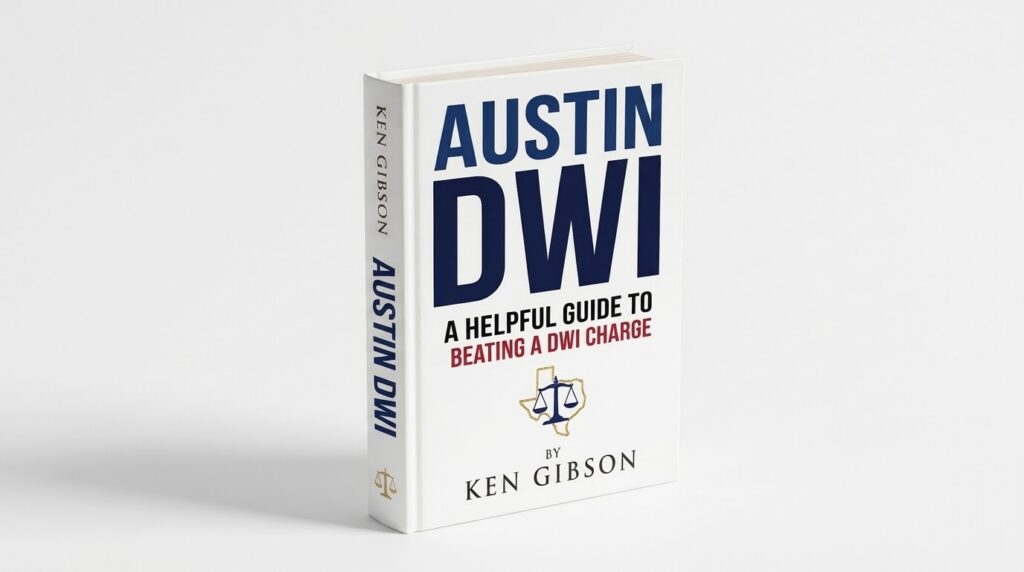
To receive a free copy of this book and schedule a free case evaluation with Ken Gibson, please submit your contact information below.
Schedule a Free Case Evaluation Online